
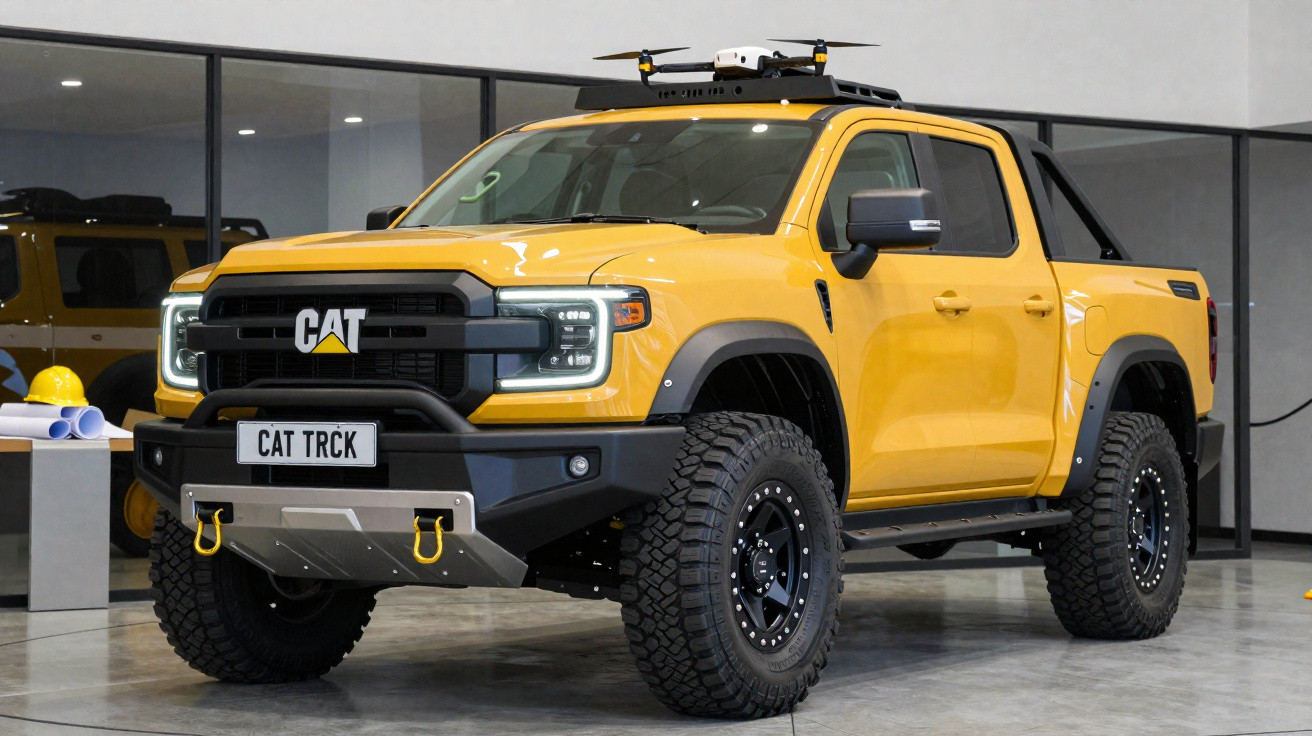
Caterpillar, a name usually associated with bulldozers and excavators, is now stepping into the automotive space. The brand’s first pick-up is intended to be less of a lifestyle truck and more of a rolling command centre for major construction sites - complete with V8 muscle, a drone platform and artificial intelligence on board.
Why Caterpillar is suddenly building a vehicle
For nearly 100 years, Caterpillar has stood for yellow giants: tracked excavators, dozers, wheel loaders and diesel generators. When people think of the brand, they picture open-cast mines rather than petrol stations - which is exactly why its move towards road vehicles feels so unexpected.
While groups such as Volvo or Hyundai have long developed lorries, buses and construction machinery side by side, Caterpillar largely kept away from road-legal vehicles. The company focused on working equipment, not transport. Now the US manufacturer is breaking with that tradition and entering new territory with its own 4×4 pick-up.
From a strategic standpoint, the timing adds up. Construction sites are becoming more complex, more digital and more connected. Demand is rising for vehicles that do more than simply move materials from A to B. Caterpillar sees a gap between a conventional pick-up and a heavy lorry - and positions the new “Cat Truck” squarely in that middle ground.
“The Cat Truck is less car and more tool - a multifunctional hub for safety, control and heavy loads on major construction sites.”
The Cat Truck: a Ford in Caterpillar clothing
Caterpillar has decades of experience building tough drivetrains and chassis for off-road machinery. What it does not have is deep practice with crash testing, type approval, comfort requirements and everything else a road vehicle demands. So the group has brought in an experienced partner: Ford.
The engineering starting point for the new Cat Truck is the Ford Ranger Super Duty - a particularly rugged, high-towing version of Ford’s pick-up. The frame, drivetrain and many suspension components come directly from Ford. Caterpillar’s role is to focus on modifications, additional systems and an industrial-use concept.
You can still spot the origins in the overall shape - but not immediately. The biggest visual changes are at the front: wider headlamps, a reworked bumper, and a massive, near-vertical grille treatment in CAT style. At the rear, a reinforced load bed signals that this pick-up is designed for heavy work rather than weekend DIY runs.
V8 Powerstroke: 500 PS as a working tool
Under the bonnet is not an experimental power unit but a proven workhorse: Ford’s 6.7-litre V8 “Powerstroke”, familiar from the F-350 Super Duty. In the Cat Truck configuration, the engine produces around 500 PS and delivers a huge 1,356 Nm of torque.
On paper, those figures can sound like pub-talk bragging rights. On a major site, they mainly mean one thing: margin. The V8 is intended to pull several tonnes of tools, spare parts, containers or trailers across loose ground without constantly operating at the limit.
| Model | Engine | Power (PS) | Torque (Nm) |
|---|---|---|---|
| Cat Truck (Caterpillar) | V8 Powerstroke 6.7 l | 500 | 1,356 |
| Ford F-350 Super Duty | V8 Powerstroke 6.7 l | 500 | 1,356 |
The interesting question is power take-off. The engine has ample headroom to drive auxiliary equipment directly - such as hydraulic pumps or high-output compressors. That is precisely where it differs from a typical private-customer pick-up.
A mobile lead vehicle, not a lifestyle pick-up
Caterpillar is explicitly not positioning the Cat Truck as a lifestyle model. Instead, it is aimed at larger infrastructure and mining projects, acting as the link between office cabins, the machine fleet and site safety teams.
The developers define three core tasks:
- Safety: monitoring staff, spotting hazards early and controlling access.
- Supervision: keeping an eye on build progress, machine utilisation and material flows.
- Maintenance: getting technicians and spare parts to the right machine quickly and running diagnostics on site.
To support this, the cab is packed with electronics. A driver fatigue monitoring system checks alertness. Cameras, infrared sensors and gaze tracking can detect signs of overload and issue warnings. On large projects with long shifts and night operations, such a system can significantly reduce accident risk.
“The Cat Truck becomes a moving control room: driver assistance, data access and communications systems converge in one central place.”
Drone platform and AI assistants on board
Perhaps the most unusual part of the concept is the integrated drone platform. From the pick-up, autonomous drones can be launched to map the site, check material storage areas or monitor critical zones from the air.
Typical use cases could include:
- inspecting embankments after heavy rainfall
- quickly overflying restricted areas without putting staff at risk
- counting and locating material stockpiles and containers
- documenting construction progress for clients
Alongside this, Caterpillar is banking on AI-supported voice assistants. They are intended to guide site personnel through maintenance procedures, read out checklists or log safety checks while hands remain free. In harsh environments where tablets quickly become dusty or damaged, interaction shifts more towards speech.
Market strategy: why Europe misses out
Caterpillar is still saying nothing about pricing. Details on trim structure, possible variants or a launch timetable are also missing. One message, however, is clear: for now, the Cat Truck is not planned for Europe.
That comes down to several factors. For one, the intended operating regions are areas with very large, sometimes remote sites - such as North America, Australia or mining operations in parts of Latin America. In addition, EU emissions and noise rules, as well as toll systems, would not exactly favour a heavyweight V8 diesel.
For the European market, Caterpillar is currently thinking in different categories: telematics, fleet management for construction equipment, or electrically assisted solutions on site. A 6.7-litre V8 pick-up sits awkwardly in debates about climate targets and urban mobility shifts.
What the Cat Truck means for the construction industry
Caterpillar’s move says as much about the construction sector as it does about a single pick-up. Sites are evolving into connected ecosystems. Sensors, data analysis and automation are moving closer to the day-to-day work of site supervisors.
The Cat Truck brings together several trends:
- Digitalisation: real-time data on machines, materials and people flows directly into the vehicle.
- Automation: drones and assistance systems take over routine tasks.
- Integration: vehicle, machine fleet and control centre operate within the same data environment.
For operators of large fleets, this creates a new kind of tool. Rather than simply buying machines, they build a sort of “site cloud”, with the Cat Truck acting as a physical interface. Anyone already investing in BIM models, connected sensors and digital twins gains a practical bridge into everyday operations with a vehicle like this.
Practical example: a day with the Cat Truck
What might a typical day look like on a major site? One plausible scenario:
Early in the morning, the Cat Truck is among the first vehicles to enter the site. Machine data collected overnight has already been synchronised. A dashboard in the cab shows which units are reporting maintenance needs or unusual values.
From the pick-up, the foreman launches two drones to survey critical zones: a newly built ramp and a slope with erosion risk. The aerial footage feeds straight back into the vehicle, is analysed automatically and flags suspicious areas. At the same time, the fatigue monitoring system warns the driver of early signs of exhaustion - not uncommon after several night shifts.
Later in the day, a mechanic team uses the Cat Truck to reach an excavator showing a fault message. On site, an AI assistant pulls up the correct step-by-step troubleshooting guide. The technician uses voice commands while working on the machine. The pick-up remains nearby with the engine running and supplies additional measuring equipment via its power system.
By day’s end, a complete log is available: maintenance actions, safety checks, drone flights and the locations of key machines. Much of it happens without paper, without scribbled notes and without mysterious spreadsheet files.
Opportunities and risks of the new strategy
For Caterpillar, the Cat Truck opens several opportunities - and a few potential pitfalls. The biggest upside is that the group expands its portfolio without starting from scratch. Ford contributes series-production experience, crash safety and road approval; Caterpillar brings heavy-duty expertise and digital construction-site solutions.
The risks lie elsewhere. Fleet customers understand Ford dealer networks, warranty terms and service intervals. How responsibility and costs will be split between Ford and Caterpillar remains unclear. The high weight, fuel consumption and V8 diesel will also be viewed critically in some markets.
At the same time, the Cat Truck could serve as an entry point. Customers who already run an all-CAT fleet may see the pick-up as a natural addition. Psychologically, moving from a yellow tracked excavator to a yellow lead vehicle is a smaller leap than switching from a purely civilian pick-up to an industrial-vehicle brand.
What this means for other manufacturers
Caterpillar’s move is likely to put competitors on alert. If a traditional machinery manufacturer is planning a “construction-site vehicle” with drones and AI, the boundary between commercial vehicle, working tool and IT platform is being redrawn. Other heavyweights such as Komatsu, Liebherr or Hitachi may explore similar concepts - perhaps with alternative powertrains or tighter integration into existing telematics systems.
For the automotive industry, this adds pressure to offer industrial specialist solutions rather than thinking of pick-ups purely as leisure vehicles or tradesmen’s trucks. The Cat Truck shows how far a commercial vehicle can move away from its production-model roots without losing its base.

Comments
No comments yet. Be the first to comment!
Leave a Comment