
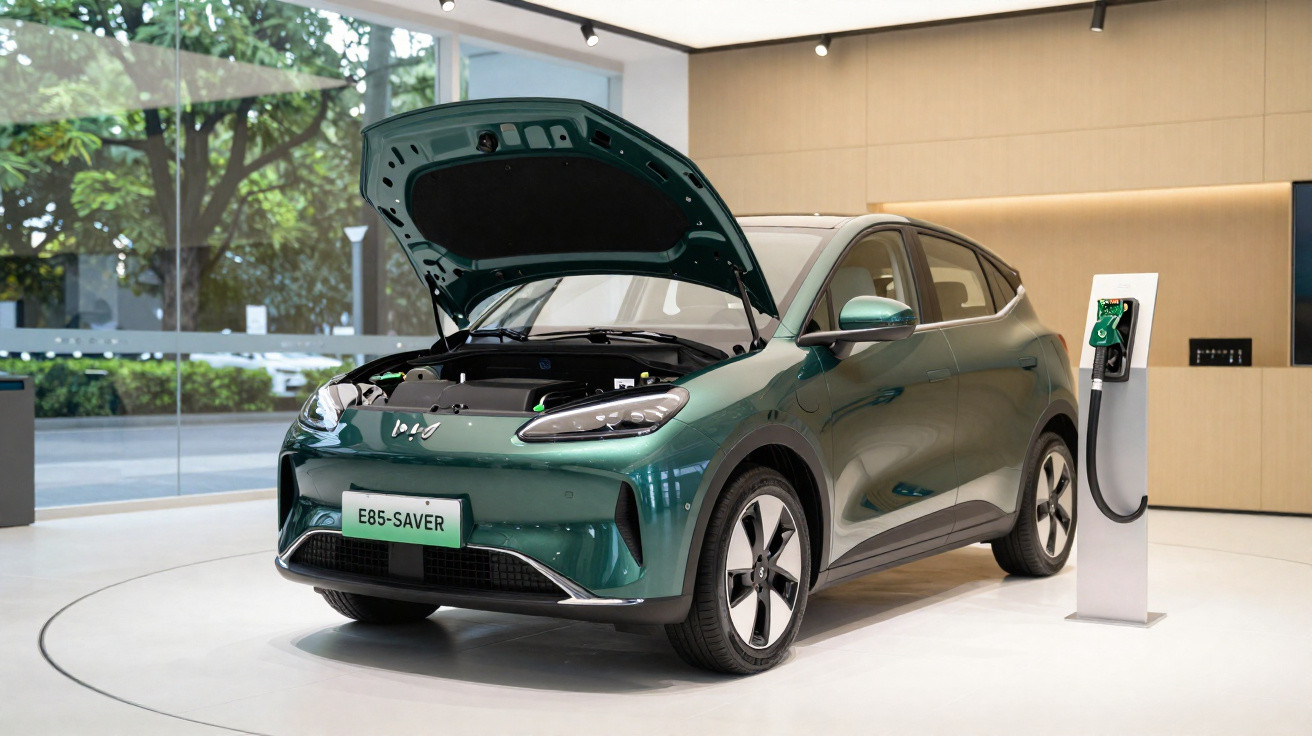
Fuel prices at the pump rise and fall, and many commuters wince when they look at their fuel receipts. Yet if you drive a petrol car, there is a way to switch to a much cheaper fuel using a dedicated conversion kit. A small control unit fitted in the engine bay can turn an ordinary car into a money-saver - legal, regulated, and no longer a niche solution.
Why a discreet little box can slash what you pay to fill up
The idea is straightforward: in many countries, including Germany, the number of filling stations offering Superethanol E85 is growing. This fuel is made largely from ethanol - an alcohol produced mainly from sugar beet and cereals. At the pump, the price per litre is usually well below that of conventional unleaded.
"If you consistently fill up with E85, you can almost halve your pure fuel costs per tank - depending on how you drive."
Official price comparisons show the scale of the gap. While Super E10, Super 95 or Super Plus 98 are often well above €1.80 per litre, E85 frequently sits somewhere between €0.80 and €1.00 per litre. For a 50-litre tank, that can look roughly like this:
- 50 litres of Super: about €90
- 50 litres of E85: about €40 to €50
- Saving per fill-up: about €40 to €50
That is exactly where the so-called FlexFuel control unit comes in, because not every petrol engine is designed at the factory to tolerate such a high ethanol content.
What Superethanol E85 is - and who it makes sense for
Superethanol E85 contains up to 85% ethanol depending on the season, with the remainder being standard petrol. The high alcohol share not only reduces the price; it also changes how combustion behaves. Some engines handle it without any changes, while others need electronic assistance.
The typical trade-off is:
- The fuel is noticeably cheaper per litre.
- With E85 the engine uses slightly more fuel, usually 15% to 25%.
- Even so, the cost per mile is still clearly lower overall.
If you cover a lot of miles - for example, commuting daily or regularly driving long distances - you tend to notice the difference most. Households in rural areas in particular, where the car is essential and public transport is rarely a genuine alternative, are increasingly looking for exactly this kind of saving.
How a FlexFuel control unit works in the engine bay
Many modern petrol cars already have sensors and software capable of recognising different fuels. Older or more basic models often do not. In those cases, an add-on device is used, typically sold as a FlexFuel control unit or an E85 conversion kit.
Measuring rather than guessing what is in the tank
The unit is installed in the engine bay and connected to the fuel injection system. It detects how much ethanol is actually present in the fuel and then adjusts injection quantity dynamically. That allows the engine to run on:
- pure unleaded petrol
- pure E85
- or any mixture in between
The driver does not have to change any settings, press buttons, or navigate menus. You simply fill up with whatever is available or cheapest, and the electronics handles the rest in the background.
"The car becomes, in a sense, ‘bilingual’: it understands both normal fuel and ethanol - and, when in doubt, it develops its own fuel strategy."
Legal requirements and who is allowed to fit one
In many countries, installation is clearly regulated. It is not enough to buy a random box online and fit it yourself. Only trained specialist garages with the appropriate approval are permitted to carry out an official conversion. They make sure that:
- the correct unit is selected for the specific engine type
- the installation is completed properly
- the relevant regulations are complied with
- the vehicle documents are updated accordingly
Important: this technology is only suitable for petrol cars. Diesel vehicles cannot legally be converted to ethanol using this approach.
What drivers should budget for - and when it pays back
The price of a FlexFuel system varies by vehicle: number of cylinders, injection technology and labour involved. As a broad guide, complete packages including the control unit and installation tend to fall between about €700 and €1,500.
What matters is how you use the car afterwards. If you only drive 5,000 km per year, it naturally takes longer before the investment pays for itself. If, on the other hand, you commute every day and reach 20,000 km or more per year, the savings become noticeable much sooner.
"Many calculations conclude that the conversion can pay for itself within one to two years, depending on annual mileage."
In some areas, local authorities or federal states support a switch to E85 with grants. That can reduce your out-of-pocket cost significantly and bring the break-even point forward.
| Annual kilometres | Potential saving per year* | Payback time with €1,000 installation cost |
|---|---|---|
| 10,000 km | approx. €400–600 | around 2 years |
| 20,000 km | approx. €800–1,200 | about 1 year |
| 30,000 km | approx. €1,200–1,800 | well under 1 year |
*Indicative figures, depending on consumption, driving style and price differences at the pump.
Where the limits of this fuel-saving option lie
As tempting as “half the tank price” sounds, it is not the perfect solution for everyone. A few factors temper the excitement:
- Not every engine is technically approved.
- On newer vehicles, the conversion can affect the manufacturer’s warranty.
- Some garages are sceptical about the idea and have little hands-on experience.
- The E85 filling-station network has expanded, but it is still not complete everywhere.
The higher consumption with E85 also needs to be kept in mind. If you already drive a thirsty SUV, you may save a lot per litre but you will have to refuel more often. For high-mileage drivers in the small family car or mid-size segments, the sums often work out better.
What to check before going ahead with a conversion
If you are considering making your petrol car E85-capable, it is unwise to focus only on the device price. Just as important are:
- detailed advice from a specialist garage
- clear confirmation of compatibility with your exact engine type
- documentation showing the conversion kit’s approval
- information on updating the vehicle documents after installation
It also helps to do a realistic calculation: how many kilometres do you drive per year? How many E85 pumps are genuinely practical on your regular routes? Is any insurance surcharge likely - if one applies at all? Answering those questions honestly makes it much easier to judge whether the numbers add up.
Technical view: why ethanol does not automatically damage an engine
Ethanol behaves differently from pure petrol. It absorbs more water, cools more strongly as it evaporates, and has a different energy density. Modern FlexFuel systems account for this by lengthening injection times and controlling mixture formation.
With correct calibration, an engine generally tolerates a high ethanol share well. Problems tend to arise when unapproved DIY solutions are used, or when parts of the fuel system are not designed for ethanol. That is why reputable providers rely on components that do not overstress seals, fuel lines and pumps.
Another point many readers consider: E85 is seen as more climate-friendly than conventional fuel because the plant-based origin of ethanol offsets part of the CO₂ balance. That does not directly reduce your spending, but for environmentally minded drivers it is increasingly relevant when deciding.
Practical examples: who benefits most from the money-saving box
In day-to-day use, three groups tend to gain the most:
- Long-distance commuters who drive many kilometres to work every day and cannot easily switch to public transport.
- Families with a second car where an older petrol model is a good technical candidate for conversion.
- Mobile workers and field staff who spend a lot of time on motorways and can plan routes around E85 stations.
If, by contrast, you only drive a few thousand kilometres per year and live a long way from the nearest E85 pump, the potential is far smaller. In that situation a different saving approach may be more sensible, such as a more efficient vehicle or car sharing.
Ultimately, this is not a miracle cure - it is a robust technical option that can make many petrol cars much cheaper to run. For the driver in the opening example, a single control unit in the engine bay was enough to almost halve the fuel bill, at least for as long as E85 keeps its price advantage at the pump.



Comments
No comments yet. Be the first to comment!
Leave a Comment