
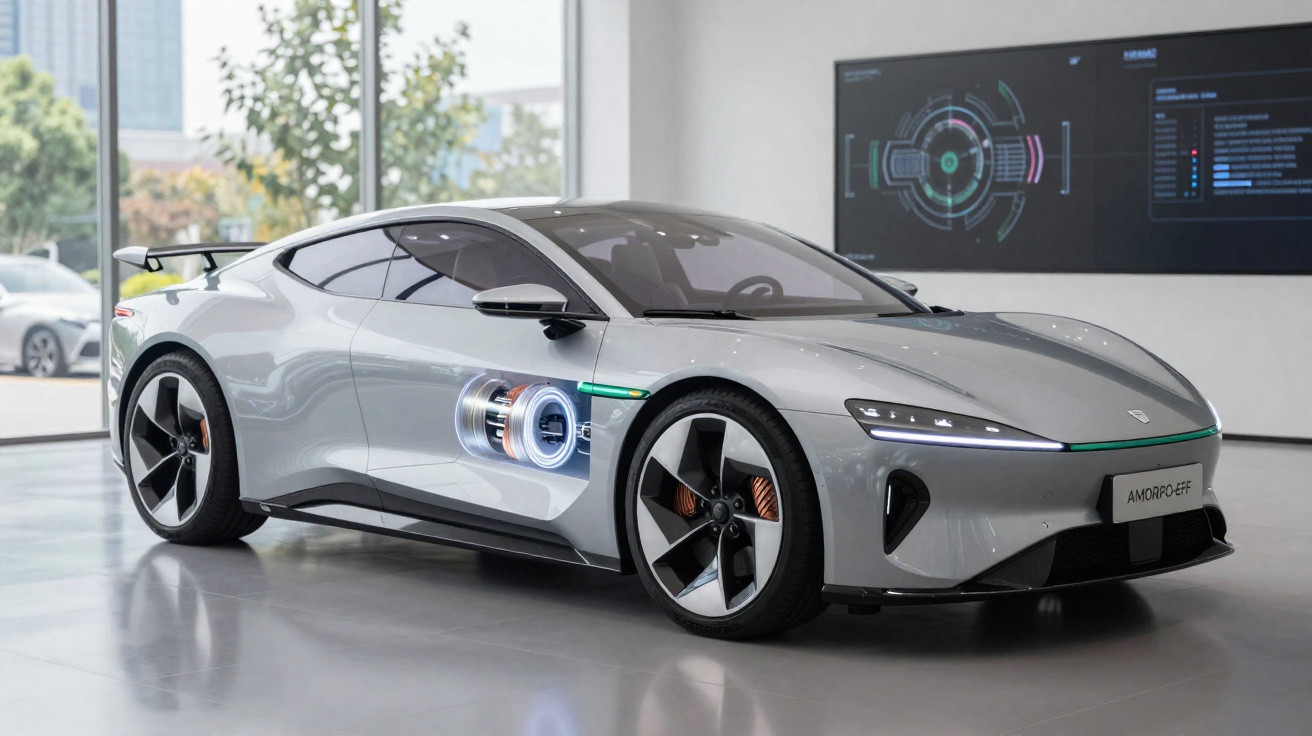
Renault and the Chinese car maker Geely, through their joint powertrain venture Horse, are claiming a technical milestone. Its new electric motor, called Amorfo, is said to achieve 98.2% efficiency, pushing close to the physical limits of what is feasible. Behind that simple figure sits a set of atypical engineering choices - and the prospect that hybrids and EVs could become noticeably more economical in the years ahead.
What sits behind the French–Chinese partnership
Horse operates as a standalone company set up by Renault and Geely to consolidate powertrain engineering, spanning internal combustion engines, hybrid systems and electric motors. While European brands have recently leaned heavily into dedicated electric platforms, Geely has been steadily and quietly strengthening its driveline development in the background. The Amorfo motor comes directly out of that overlap.
The unit is aimed primarily at hybrid vehicles, where an internal combustion engine and an electric motor work together. Range-extender layouts and especially efficient plug-in hybrids are also part of the target. With 190 hp and 360 Nm of torque, the Amorfo sits squarely in the mid-market on paper rather than the supercar arena. The attention here is driven by efficiency, not outright output.
“According to the manufacturer, Horse’s Amorfo motor achieves an efficiency of 98.2% and halves internal losses compared with conventional electric motors.”
The trick is in the material: amorphous steel in the stator
At the core of the motor is the stator - the stationary section that generates the magnetic field used by the rotor. Traditionally, stators are built from thin laminations made of crystalline electrical steel. Horse takes a different approach by using amorphous steel.
What does “amorphous” steel actually mean?
Unlike conventional steel, an amorphous metal has atoms arranged in a disordered structure, more like glass than a regular crystal lattice. That structural difference significantly changes magnetic behaviour: magnetisation losses are reduced, and eddy currents can be suppressed more effectively. Those eddy currents account for a noticeable share of energy loss in many traditional electric motors.
In the Amorfo motor, the stator laminations are just 0.025 mm thick - around ten times thinner than in a typical mass-produced electric motor. That puts them in the region of a human hair thickness, or even finer.
- Material: amorphous steel instead of conventional electrical steel
- Lamination thickness: 0.025 mm rather than roughly 0.25 mm
- Aim: halve magnetic and electrical losses within the stator
- Lab result: 98.2% efficiency
Using such ultra-thin sheets restricts the formation of eddy currents - unwanted loops of current induced within the metal itself. Those currents convert part of the electrical input into heat, meaning energy that never makes it to the wheels. The thinner the laminations, the less room these effects have to develop.
How big the efficiency leap really is
Depending on operating point, today’s electric motors already reach roughly 93% to 97% efficiency. That naturally raises the question: does 98.2% make any real difference day to day?
The candid answer is that, on a car’s consumption display, you are only talking about a few tenths of a percentage point here and there. Horse itself estimates that, at the level of a complete hybrid system, the improvement is around 1% lower energy demand. That sounds minor, but it matters in two ways:
| Parameter | Typical electric motor | Amorfo motor (Horse) |
|---|---|---|
| Efficiency (lab, peak) | 93–97 % | 98.2 % |
| Internal losses | 100 % (reference) | approx. 50 % of the reference |
| System effect in a hybrid | baseline | ~1 % lower energy consumption |
At vehicle level, further losses always come into play: inverter, gearbox, battery chemistry and tyres. The motor is only one component in the chain. On top of that, the peak-efficiency point occurs in a narrow operating window that is not held consistently in everyday driving. That is why 98.2% in the lab can quickly translate into roughly 1% less consumption on the road.
“A one-percent reduction in energy use may seem unremarkable for a single car - but scaled across millions of vehicles over many years, the effect becomes clearly measurable.”
Why manufacturers fight for seemingly tiny percentage points
In Europe, CO₂ limits apply significant pressure; in China, efficiency metrics feed into subsidies and fleet assessments. Every percentage point saved reduces potential penalties, improves ratings and gives manufacturers more leeway to offer larger and heavier body styles without immediately stepping up into a higher CO₂ bracket.
For fleet operators - such as car-sharing services or delivery companies - a 1% reduction in consumption can translate into several hundred pounds of energy savings over a vehicle’s life. The impact becomes even more meaningful when incremental gains stack up across the entire drivetrain: a more efficient motor, lower-loss power electronics, optimised thermal management and tyres designed for low rolling resistance.
Between the lab and the road: open questions around the Amorfo motor
For now, the Amorfo remains a test-bench powertrain. Horse has published performance figures and the efficiency claim, but not a specific production model. There is also no timeline for when the motor will first appear in a Renault or a Geely-derived brand.
In real-world operation, additional factors come into play that are hard to reproduce fully in a laboratory setting:
- temperature swings from deep sub-zero conditions to heatwaves
- mechanical vibration, pothole impacts and long-term load cycles
- manufacturing tolerances with ultra-thin laminations
- ageing effects in the amorphous steel and insulation materials
A particularly important unknown is how well the production of these stators can be scaled to high volumes. Amorphous steel is demanding to process. The sheets must be stacked and insulated with great precision; small imperfections can erase part of the efficiency advantage.
What Amorfo could mean for hybrids and electric cars
In an ideal scenario, the motor enables three different approaches depending on the vehicle concept:
- the same performance with a slightly smaller battery, reducing cost
- the same battery size but more range or lower consumption
- more performance for the same consumption, for example in heavy SUVs or vans
Renault could, for example, use Amorfo in future E-Tech hybrids to trim WLTP-cycle consumption by a few tenths of a litre. For Geely brands such as Volvo or Lynk & Co, a particularly efficient electric motor could be a selling point in markets where taxation is closely tied to CO₂ figures.
How to picture the everyday impact
Consider a simple example: a plug-in hybrid uses 18 kWh per 100 kilometres in electric mode. If the drivetrain becomes around 1% more efficient thanks to the Amorfo motor, the calculated figure drops to roughly 17.8 kWh. A driver is unlikely to notice that directly on the display. Over 150,000 kilometres, however, the difference adds up to around 300 kWh.
At an electricity price of 35 pence per kWh, that single car saves about £100. That may look modest - but if a group sells one million such vehicles, the customer-side savings reach the hundreds of millions, alongside several terawatt-hours of electricity that never need to be generated.
Risks and limits of the new technology
Any new materials technology introduces risk. Amorphous steel costs more than conventional electrical steel sheet. If the material price rises significantly, the business case for the efficiency gain can quickly weaken. Questions also remain around repairability and recyclability, because ultra-thin, specially alloyed laminations create fresh challenges for dismantling and recycling operations.
One further point: a motor with such low losses generates less heat through self-warming. That sounds beneficial, but it can force engineers to manage temperatures with greater precision. In cold conditions, the motor itself - and potentially the battery - needs to be brought into an efficient operating window more quickly. Only then can the technology deliver its full potential.
Why it is still worth paying attention to efficiency
The Amorfo motor is emblematic of a new phase in the competition over powertrain technology. After years in which range, charging speed and battery capacity dominated headlines, the more prosaic topic of efficiency is moving back to centre stage. In markets where subsidies are no longer growing, a meaningful efficiency advantage can be decisive when customers are choosing between two similar models.
For end users, it will increasingly pay to look beyond horsepower figures and battery size. How efficiently a car turns 1 kWh of electricity into real-world miles shapes long-term running costs, residual value and the overall CO₂ footprint. With its headline number, Amorfo puts that conversation back on the agenda - and applies pressure on rival manufacturers to rethink how they design and build electric motors.
Comments
No comments yet. Be the first to comment!
Leave a Comment