
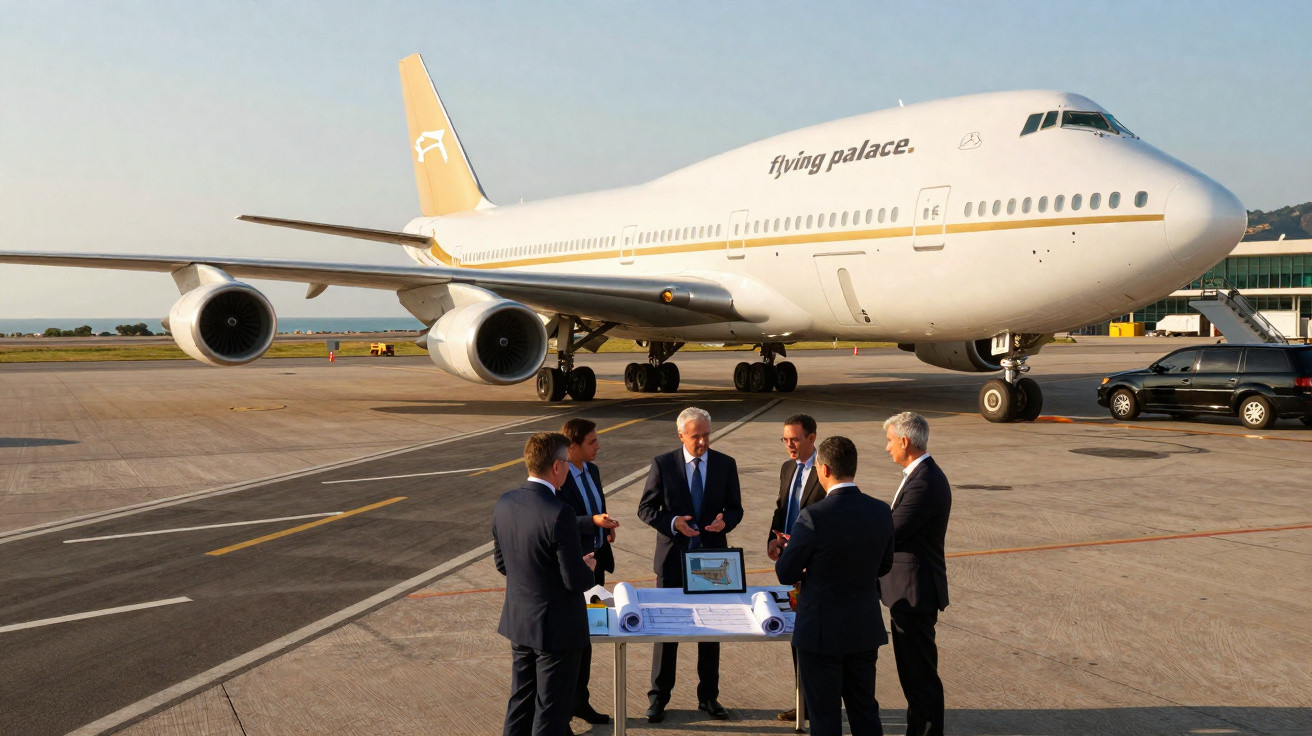
In Sardinia’s peak summer season, a particularly influential visitor arrived with an aircraft so large that the island quite literally had to adjust around it.
At the centre of the story are the Emir of Qatar, a Boeing 747-8 converted into a flying palace, and an Italian holiday airport that had to be reworked to accept the jet. It reads like the plot of a billionaire drama series, yet it affected real infrastructure on the Costa Smeralda and shows how financial clout can reshape even civil aviation rules.
A holiday jet far beyond the usual scale in Italy
The key figure in this episode is Tamim bin Hamad Al Thani, Emir of Qatar, and his Boeing 747-8 BBJ - the executive version of Boeing’s longest aircraft. In normal airline service, the type can carry more than 400 passengers. In the Emir’s configuration, however, much of that volume is dedicated to high-end comfort: suites, meeting rooms, relaxation spaces and entertainment areas.
For the Qatari royal family, the go-to summer destination in Europe is Sardinia’s Costa Smeralda, a stretch of coastline that has attracted celebrities, business leaders and megayacht owners for decades. The difficulty is that Olbia Airport - the main gateway to the area - was never designed for an aircraft of this size.
The Emir’s Boeing 747-8 did not fit within the aircraft category Olbia Airport was authorised to handle, forcing a complete rethink of the airport’s infrastructure.
Ordinarily, if an airport is not certified for a particular aircraft type, pilots must divert to an alternative destination - typically a major international hub. But when the passenger is a head of state with significant economic interests in the region, the usual constraints can look very different.
Why airport coding rules created a deadlock
To see why this became a problem, you need to look at the International Civil Aviation Organization (ICAO) standards. Every airport is assigned a reference code that reflects, among other things, what wingspans it can safely accommodate on runways and taxiways (the ground routes aircraft use to move around).
Olbia Costa Smeralda operated comfortably as a Code E airport. That level already supports large wide-body aircraft such as the Boeing 777 and Airbus A330 - familiar types on long-haul international routes.
The catch is that the Boeing 747-8, like the Airbus A380, falls under Code F - the realm of the true giants. The 747-8 has a wingspan of around 68.4 metres, which requires greater safety margins on taxiways and manoeuvring areas.
- Code E: Boeing 777, Airbus A330, much of intercontinental traffic.
- Code F: Airbus A380, Boeing 747-8 and other specialised superjumbos.
- Direct impact: wider pavements, larger safety strips and strengthened surfacing.
Under the original setup, the Emir’s 747-8 could not have used Olbia: the certification was missing and the risk profile was too high. That would have meant landing at a larger airport and then moving the delegation onwards by road or by smaller aircraft.
When a customer effectively redesigns an airport
Qatar’s footprint in the area is substantial. The sovereign wealth fund Qatar Investment Authority (QIA) owns Costa Smeralda Holding, which controls an important share of local tourism infrastructure. In other words, the Emir is, in practical terms, both a customer and something close to the host.
Faced with the logistical obstacle, the solution was not to switch to a smaller aircraft. Instead, the airport was upgraded. Officially, the rationale centred on improving the handling of large aircraft and reinforcing high-end tourism.
The works required to accommodate the Emir’s jet included widening taxiways, strengthening the asphalt structure and making safety adjustments, lifting Olbia to the sought-after Code F category.
The upgrade programme included:
- Widening ground movement areas to suit the aircraft’s wingspan.
- Reinforcing apron and runway pavement to cope with take-off weights of up to around 440 tonnes.
- Reassessing separation distances between runways, taxiways and obstacles in line with ICAO guidance.
- Updating technical documentation and the region’s aeronautical charts.
As a result, Olbia gained certification to operate Code F aircraft. That is unusual for tourist airports on islands, which typically cater to regional jets and medium-to-large airliners, rather than superjumbos.
A flying palace and the logic of haute plaisance
In the world of ultra-wealth, the term haute plaisance is used for leisure at an extreme scale: megayachts, private ski chalets, exclusive islands and, naturally, VIP jets. A Boeing 747-8 BBJ sits squarely in that universe.
Unlike a densely seated airline layout, a VIP configuration can include:
| Space | On-board purpose |
|---|---|
| Suites | Bedrooms with a king-size bed, large bathrooms and five-star hotel-style finishes |
| Meeting rooms | Areas for government or business discussions, with secure communications systems |
| Staff area | Dedicated spaces for expanded crew, security teams and advisers |
| Medical facilities | A small on-board clinic with equipment for emergencies |
An aircraft like this is more than transport. It operates as an extension of the official palace, offering a level of security and privacy that is hard to match with smaller jets - which helps explain why changing aircraft was not treated as the preferred option.
Benefits and dilemmas for Sardinia
From the region’s perspective, the works leave a mixed legacy. On the one hand, Olbia can now accept the largest aircraft in the world, potentially enabling special charter flights and direct links to distant markets, should airlines see commercial value.
On the other, it raises questions about who truly gains - and who ultimately bears the cost, directly or indirectly - of such adaptations. Airport investment often involves public funding, concessions and offsets, and prioritising luxury tourism can attract local criticism.
When the average traveller lands in Olbia on an ordinary holiday flight, they unknowingly use infrastructure strengthened largely for the comfort of one very specific passenger.
Environmental considerations also come into play. Very large aircraft burn substantial amounts of fuel and complicate emissions-reduction targets. Once an airport becomes capable of handling them, it creates room for that sort of operation, even if only occasionally.
How behind-the-scenes negotiations typically work
Infrastructure changes made at the request of heads of state or billionaires are not unique. Some airports have built bespoke hangars to house the jets of wealthy owners. In marinas, jetties have been extended to berth the superyachts of specific visitors.
In practice, the discussions usually involve local authorities, private operators and foreign investors. The most common arguments are:
- A promised increase in high-end tourism.
- Job creation during construction and through expanded operations.
- Marketing value from associating the destination with an exclusive clientele.
At the same time, residents and civic groups may challenge these priorities, pushing instead for more investment in public transport, essential services or infrastructure used by most of the population rather than a wealthy minority.
Concepts that make the story easier to follow
A few technical terms matter here and are worth a quick explanation. A “taxiway” is the route an aircraft follows on the ground between the runway and the parking stand. Its width and safety margins are calculated so that wings do not come too close to obstacles or other aircraft.
“Code E” and “Code F” are ICAO reference categories that shape airport design. The key variable in this case is wingspan - the tip-to-tip distance across the wings. A difference of only a few metres can trigger major changes in markings, dimensions and how far buildings must be set back.
Seen in that light, it is useful to imagine future scenarios to understand both upside and risk. If more holiday destinations follow the same approach, islands and small towns could end up with superhub-grade infrastructure while depending on a handful of ultra-wealthy customers. In a downturn, that kind of bet can leave airports underused and public budgets under strain.
Equally, if the modernisation is planned carefully, it can provide a foundation for broader seasonal routes, specialist cargo flights and emergency operations - such as evacuations or large-aircraft deliveries of humanitarian aid - which can be particularly relevant for island regions.
Comments
No comments yet. Be the first to comment!
Leave a Comment