
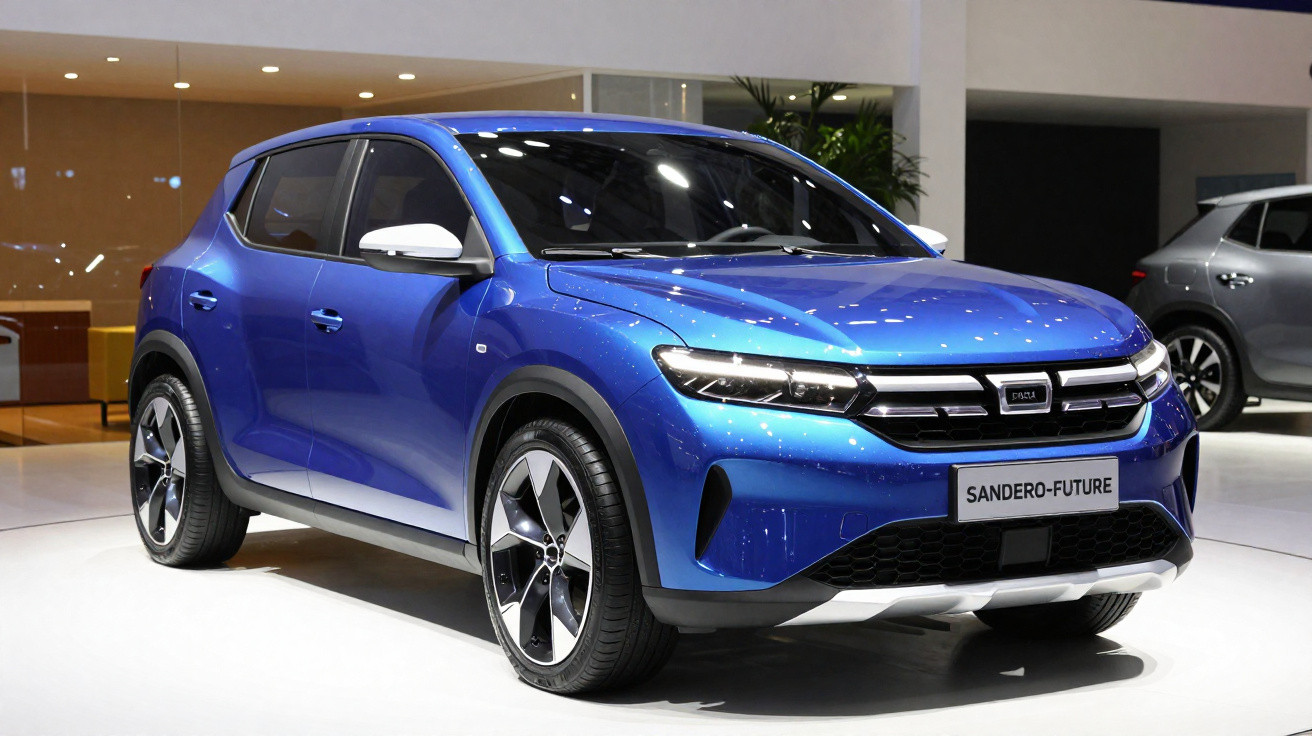
Renault is reshaping its plans for the coming decade, and that puts one of Europe’s best-known low-cost city cars at a pivotal moment.
For years, the Dacia Sandero has been the default choice for drivers wanting a no-nonsense, budget-friendly hatchback. Now it finds itself at the heart of a bigger debate: with Renault’s new FutuREady strategy nudging Dacia towards electrification, many are asking whether this unpretentious model, built in Romania, still belongs in the next generation of urban motoring.
Dacia at a crossroads with FutuREady
Renault’s FutuREady roadmap sets out how its brands - Dacia included - intend to move from conventional engines towards electrified ranges by 2030. For Dacia, a marque built on low prices and straightforward engineering, that transition needs careful handling.
At present, Dacia offers just one fully electric car in Europe: the compact Spring. The company has also confirmed that by 2030 it will add three more battery-electric models, aimed at people who want an affordable EV experience without an overload of complex technology.
Dacia is moving towards electric power, but refuses to abandon the low-cost, no-frills DNA that built its success.
Even so, Dacia is well aware that many customers still prefer familiar engines and predictable day-to-day costs. That is why the brand intends to maintain a “multi-energy” approach across its most important models. Petrol, LPG (sold as Eco-G) and hybrid powertrains will run in parallel for years yet - particularly on family-oriented vehicles such as the Jogger, Duster and the forthcoming Bigster SUV.
The newly unveiled Dacia Striker arrives as a 4.62‑metre crossover, available with multiple power options and positioned somewhere between a traditional saloon and an SUV. Its introduction signals Dacia’s intended role: less a technology trailblazer, more a practical manufacturer aiming to cover a wide spread of needs with uncomplicated, cost-conscious hardware.
What does this mean for the Sandero?
The key issue is whether the Sandero still makes sense within this evolving line-up. For the moment, Dacia’s position is unambiguous: the small hatchback is not going anywhere.
It is, after all, Dacia’s top seller in Europe. In France, over 6,500 were registered across January and February alone, outpacing the Renault Clio and even the electric Renault 5 E-Tech during that same period. Dropping a model that contributes that sort of volume would be hard to justify commercially.
The Sandero remains Dacia’s backbone in Europe, and the brand is not ready to retire it.
Dacia insiders merely refer to a “next chapter” for the Sandero. The phrase is deliberately non-specific, implying evolution rather than cancellation. There is still no confirmed launch timetable, and the current generation has only recently had its mid-life facelift - a step that normally indicates several more years on sale.
A new generation that goes multi-energy
The next Sandero is expected to follow a multi-energy template. Put simply, it should offer a range of powertrains on a shared platform. Based on the signals coming from the brand, a likely line-up would include:
- regular petrol engines for the most affordable versions
- Eco-G dual-fuel petrol/LPG options to keep running costs down
- hybrid variants designed to cut fuel consumption and emissions in urban use
This direction aligns with Dacia’s wider objective: by 2030, it wants two-thirds of its sales to be “electrified” - a category that covers full EVs, plug-in hybrids and conventional hybrids. A Sandero Hybrid, priced below better-specified competitors, could become an important tool in hitting that target.
Electric city car on the horizon, but not yet a Sandero EV
The remaining part of the story is Dacia’s all-electric offering. The current Spring may be inexpensive, but its underlying platform is showing its age and is not ideally suited to tighter safety and emissions requirements expected later in the decade. Dacia has already indicated that the Spring will be replaced within the next few years by a new, fully electric city car that will sit at the bottom of the range.
Dacia is preparing a new 100% electric city car, separate from the Sandero, to anchor the entry-level part of its line-up.
In other words, the Sandero is likely, at least at first, to remain centred on combustion and hybrid powertrains, with a different model taking on the role of the entry-level electric runabout. Whether a fully electric Sandero arrives further down the line will depend on costs, battery pricing and the pace at which European cities restrict or phase out combustion engines.
How the Sandero fits between Spring, Striker and Duster
In Dacia’s future range, the Sandero would effectively sit between an all-electric city car and the brand’s larger crossovers and SUVs. In simplified form, the structure would look like this:
| Model | Main role | Likely powertrains (future) |
|---|---|---|
| New electric city car (Spring replacement) | Urban, entry-level EV | Battery electric only |
| Sandero | Affordable compact hatchback | Petrol, LPG (Eco-G), hybrid |
| Striker | Family crossover | Multi-energy, likely including hybrid |
| Duster / Bigster | Robust SUV / larger SUV | Petrol, LPG, hybrid, possibly mild hybrid |
That positioning preserves the Sandero as the sensible option for drivers who do not want an SUV body style, but still need enough room for a small family and the ability to handle regular motorway journeys.
What drivers can expect from the next Sandero
Dacia has not released any hard technical specifications, but its recent products offer useful hints. The hybrid set-up may draw on Renault’s E-Tech technology, which is already deployed in the Jogger Hybrid. That system pairs a small petrol engine with electric motors and a compact battery, allowing short stretches of electric-only travel at low speeds.
A Sandero Hybrid would be aimed at city and suburban use, lowering fuel costs without requiring any plugging in. LPG versions should continue to appeal in countries where autogas is widely available and noticeably cheaper than petrol, including France, Italy and parts of Eastern Europe.
The future Sandero aims to offer electrified driving without the price shock of a full EV.
In terms of looks, the Sandero is expected to remain tough and uncomplicated, echoing Dacia’s current design approach: substantial bumpers, a slightly raised ride height and plastic cladding intended to cope with everyday knocks. In the cabin, anticipate durable plastics, proper physical controls for key functions, and screens that are modest but genuinely useful - all supporting Dacia’s focus on keeping production costs in check.
Affordability versus regulation: a fragile balance
Dacia’s toughest obstacle is less about the mechanical package and more about regulation. Tighter EU CO₂ limits and new safety requirements typically force prices up. On a vehicle like the Sandero, every additional sensor or mandated system can chip away at the price advantage that made it popular.
So far, Dacia’s playbook has been to satisfy safety and emissions rules with as little unnecessary complexity as possible. For instance, driver assistance features may be included in basic forms, with limited costly customisation. The same principle is likely to shape the next Sandero: no cutting-edge self-driving capability, but sufficient equipment to meet legal standards and maintain buyer confidence.
Practical implications for current and future owners
For anyone considering a Sandero today, the facelifted current model remains a sound, up-to-date choice. There is no indication of an imminent replacement next year, and Dacia models typically remain on sale for several years after a refresh. With petrol and LPG available, fuel infrastructure is unlikely to be a concern, while strong demand in the used-car market helps underpin resale values.
Buyers seeking lower CO₂ output but who are not ready to switch to a fully electric car may prefer to hold off for hybrid versions. If a future Sandero Hybrid follows the Jogger’s pricing logic, it may command a modest uplift over petrol equivalents, offset to some extent by reduced fuel spend and, in certain cities, easier access to low-emission zones.
From a cost perspective, a straightforward guideline can be useful: if most of your driving is urban and you cover under roughly 13,000 km per year, a petrol Sandero is still likely to be cheaper overall than paying extra for a hybrid. Beyond that annual distance, the hybrid starts to look financially worthwhile, particularly if fuel prices climb again.
Key terms and concepts worth understanding
If you are weighing up Dacia’s future options, a handful of recurring terms in the brand’s strategy are worth knowing:
- Electrified: Any vehicle that uses electricity as part of its powertrain, including full EVs, plug‑in hybrids and conventional hybrids.
- Hybrid: A petrol engine works alongside one or more electric motors and a small battery, which recharges through braking and does not need to be plugged in.
- LPG / Eco-G: Liquefied Petroleum Gas. Dacia’s Eco‑G models can run on both petrol and LPG, letting drivers switch to the cheaper fuel when it is available.
- Multi-energy: A vehicle or platform engineered to accommodate several different powertrains - from petrol to hybrid, and potentially even full electric - depending on market demand.
The next Sandero sits right at the meeting point of these ideas: it is intended to bridge the gap between familiar combustion power and newer low-carbon solutions, while still protecting the entry-level pricing that has shaped Dacia’s reputation.


Comments
No comments yet. Be the first to comment!
Leave a Comment