
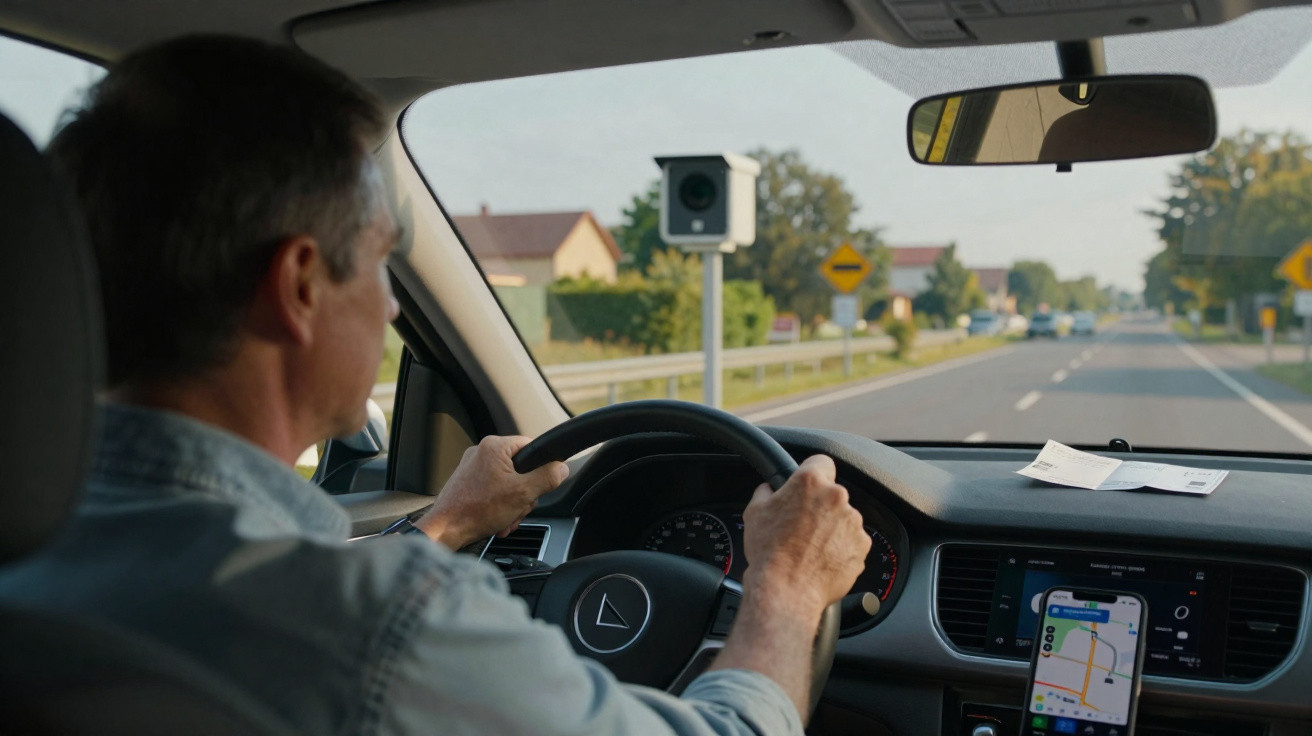
The lane ahead is clear, the children have at last settled in the back seats, and the only interruption to the peace is a small flash you barely register. Seven days later, a white envelope lands on the kitchen worktop, and your stomach knots before you even tear it open. You already know what it is.
You’re certain you weren’t over the limit. You run the moment back in your head: the flow of traffic, the sign partly obscured by a branch, the abrupt drop from 50 to 30. Now picture that, in 2025, the camera’s “tolerance” is tightened again, while politicians continue to speak about “flexibility” and “road safety”.
The updated speed camera margins are being presented as modern, fair and driven by data. In theory, some motorists may genuinely see fewer penalties. But the way these 2025 tolerances are being rolled out has the feel of a quiet scandal unfolding in plain sight.
Why the new 2025 speed camera tolerances feel like a trap
A traffic engineer I spoke to beside a suburban enforcement van put it to me with a near-shrug: “Most people aren’t speeding, they’re just drifting.” It’s that everyday “drift” the new 2025 tolerances are quietly designed to catch. For years there was an unofficial bit of breathing room: a few mph over the posted limit, reflecting the fact that speedometers vary and drivers aren’t machines.
Now those margins are being tightened, area by area, with automatic calibration and so-called “dynamic thresholds”. In theory it sounds impressively logical. In practice, it means someone sitting at 31–32 mph in a 30 zone-assuming the old tolerance still applies-can suddenly move from “fine” to “ticketed” without any obvious change on the road: no new signs, no additional warning, nothing to flag the shift. The sting isn’t only the fine; it’s the sense you’ve been caught out by the rules changing quietly.
In early autumn on a wet weekday, one commuter-belt town ran a low-key trial using 2025-style tolerances. Residents didn’t get a clear public briefing-only a hazy mention of a “road safety initiative”. For three months, along one busy 30 mph section, cameras triggered above an extremely tight threshold, with back-end data used to vary settings by vehicle type. The results were stark.
Hundreds of motorists recorded at 31–34 mph-many with clean licences-received penalty notices out of the blue. A delivery driver told me he picked up three fines on the same road within ten days. “I wasn’t racing,” he said. “I was late, stressed, but watching my speed. I thought there was still a small margin.” These days he pins the needle to 25 mph on that stretch, not because he’s suddenly had a safety epiphany, but because he’s frightened of another letter. Early internal figures suggest the crash rate there hasn’t dropped; what has increased is the number of tense drivers watching their dials instead of the road.
Look closely at the 2025 framework and the bigger issue isn’t simply how many mph are allowed-it’s who gets caught by the change. Many modern cars can under-read the true speed by 1–2 mph, while some older vehicles over-read. So two drivers, both showing 30 on their speedometer, may be treated very differently by an unforgiving camera.
Add a gentle downhill gradient, tyres with more wear, and different satnav or GPS apps reporting slightly different figures, and the “precise” tolerance starts to resemble a lottery for conscientious drivers trying to do the right thing. Officials say penalties will fall because the system targets “real” speeders more accurately. On the ground, though, small, honest slips are increasingly monetised, while the minority of persistent, aggressive speeders can still brake hard for known camera sites and accelerate again once they’re past, in the gaps where enforcement is absent.
How honest drivers can protect themselves in this new landscape
One habit suddenly matters much more under 2025 tolerances: aim for a buffer speed below the limit rather than sitting right on it. Instead of targeting 30 in a 30, many safety trainers are now quietly advising 27–28 mph in towns and cities where cameras are common. It sounds like a tiny adjustment, but it shields you from the combined effect of speedometer error, gradients and narrower margins.
The same principle applies on dual carriageways and motorways: treat 70 as 67–68, and 50 as 47–48. That can feel irritating at first, particularly if you’ve spent years relying on the much-discussed “+10% rule”. With 2025’s algorithm-led tolerances, that folk wisdom is disappearing quickly. The buffer becomes your everyday protection against surprise envelopes.
Most people are trying their best. They’re balancing work, children, late appointments, and constantly scanning mirrors, pedestrians, cyclists, satnav directions and speed limit signs. So let’s be honest: nobody manages that perfectly every single day, with flawless concentration every second. The 2025 rules don’t make you less human; they simply reduce the allowance for normal human imperfection.
If you live near an area that has recently been “modernised” for enforcement, start with one unhurried test drive at a quiet time. Pay attention to where limits drop unexpectedly, where signs are partly hidden, and where your car naturally creeps up in speed without you noticing. Think of it like walking a route before you run it. That brief reconnaissance reduces stress on real journeys and makes it far less likely you’ll be caught by invisible, tightened tolerances.
A road safety campaigner I interviewed captured the issue in one line I haven’t forgotten:
“The problem isn’t cameras. It’s when cameras become a game of ‘gotcha’ instead of a warning that helps you get home alive.”
To get through the 2025 landscape without feeling you’re at the mercy of hidden settings, a few practical anchors can help:
- Use a navigation app you trust with live speed alerts, but don’t fixate on the screen.
- Reduce your target speed by 2–3 mph below the posted limit in areas dense with cameras.
- Pay attention to places you’ve already seen cameras flash at other vehicles; these locations often coincide with new tolerances.
- If a ticket feels unfair, contest it calmly-photos and dashcam footage (if you have them) make a difference.
- Speak to neighbours and local community groups; patterns of questionable enforcement become clearer when shared.
What this quiet change says about our roads – and about trust
The most troubling part of the 2025 speed camera tolerances isn’t the engineering. It’s the gradual loss of trust between motorists and institutions. Decent drivers are told, officially, that “nothing has really changed”, yet their day-to-day experience suggests otherwise: more flashes, more penalties for 1–3 mph above what used to be tolerated, and more stress on journeys that once felt ordinary.
Most of us know the feeling of a camera flash making the heart jolt, even when you’re fairly sure you’re within the limit. Spread that across thousands of trips and you don’t automatically create safer roads. You create drivers who feel monitored, criticised and quietly punished for being human. Some people slam on near cameras and then speed up angrily afterwards. Others become resigned, convinced that “you’ll get done one day whatever you do”. Neither response supports calm, attentive driving.
There is an alternative, and it doesn’t require fantasy technology: clear, openly communicated tolerances; warning signs you can actually see, rather than ones hidden by overgrown foliage or placed after a confusing junction; cameras installed where evidence shows genuine risk, not simply where budgets need topping up. And yes-enforcement that prioritises truly reckless behaviour: the phone-in-hand driver doing 50 through a busy 30, not the parent at 32 who eased off the accelerator a fraction too late.
The 2025 tolerances could have been a chance to modernise enforcement while rebuilding public confidence. As things stand, they risk achieving the opposite. That’s why so many careful drivers experience this shift less as a safety upgrade and more as a quiet scandal playing out on the roads they use every day.
| Key point | Detail | Why it matters to you |
|---|---|---|
| New, tighter tolerances | The “+10%” margins are gradually being replaced by stricter automatic thresholds | Explains why speeds that once slipped through are now triggering fines |
| Impact on conscientious drivers | Small drifts of 1–3 mph are penalised more often, even for drivers with good records | Helps you spot situations where you may be flashed despite thinking you’re compliant |
| Buffer-speed driving strategy | Adopt a “buffer speed” 2–3 mph below the posted limit | Significantly reduces the chance of penalties caused by the new tolerances |
FAQ:
- Are the 2025 speed camera tolerances officially the same everywhere? Not really. Authorities talk about national guidelines, but in practice thresholds can vary by region, camera type and even specific location.
- Can a difference of just 1–2 mph really trigger a fine now? In many modern systems, yes. The combination of stricter margins and precise digital measurement means tiny overruns can be enough.
- Is it worth challenging a ticket based on tolerance arguments? You can try, especially if signage is unclear or your speed reading was borderline. Strong evidence like photos or dashcam footage helps.
- Do newer cars suffer less from these tight tolerances? Not automatically. Some newer speedometers underread slightly; others rely on software corrections. You still need a small safety buffer.
- What’s the safest everyday habit to avoid surprise fines in 2025? Drive a couple of mph under the posted limit in camera zones, use audible speed alerts, and stay extra alert near sudden limit changes.



Comments
No comments yet. Be the first to comment!
Leave a Comment