
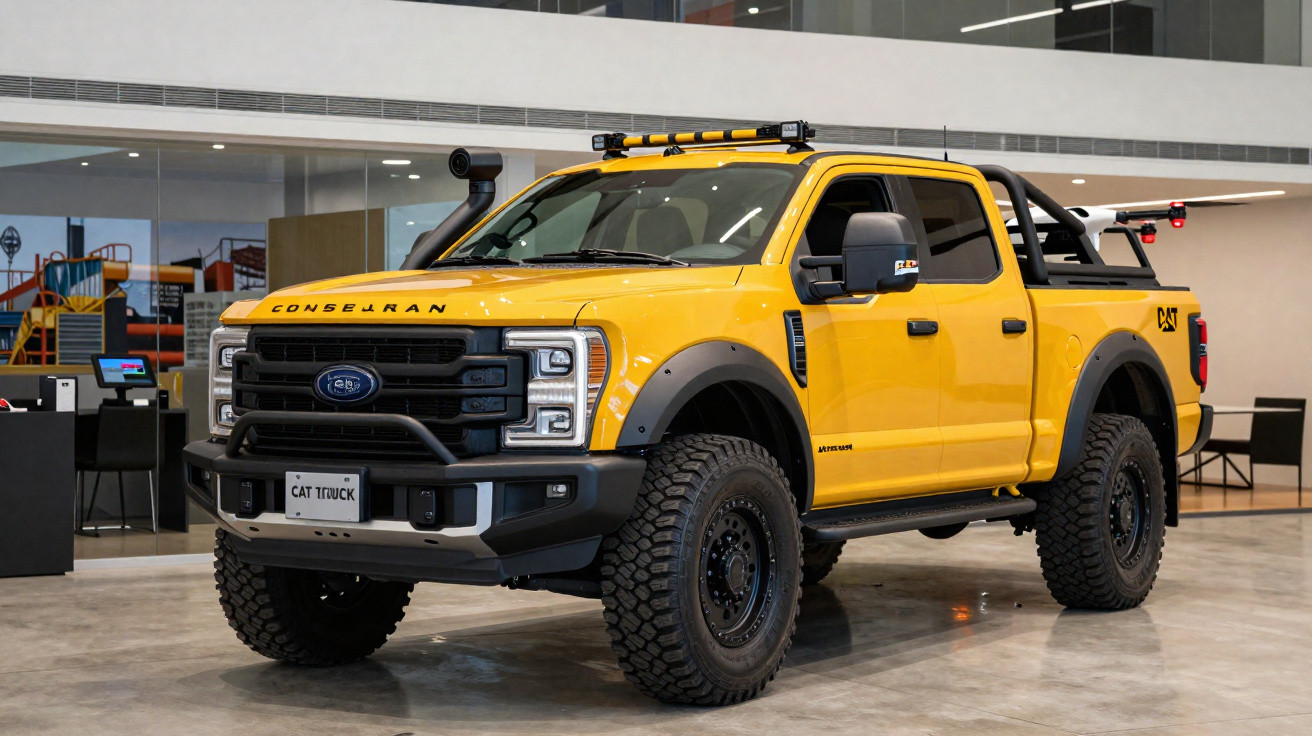
The American powerhouse is now aiming to get involved in the pickup world as well.
Known far more for bulldozers and excavators, the company has discreetly joined forces with Ford to introduce a heavy-duty 4×4 pickup called the Cat Truck. Rather than targeting suburban driveways, it is built for major construction operations, combining Ford’s established mechanicals with Caterpillar’s industrial systems and safety technology.
Caterpillar swaps bulldozers for a road‑legal 4×4
Caterpillar has produced construction equipment since 1925, beginning in Texas and expanding to almost every continent. The name appears on everything from diesel generator sets to enormous mining hauliers that make ordinary lorries look like toys.
For decades, however, Caterpillar avoided putting its badge into the road-vehicle arena. While brands such as Volvo and Hyundai sell commercial road vehicles alongside heavy equipment, Caterpillar largely stuck to supplying engines and components-without placing “CAT” on the nose of anything wearing number plates.
That approach shifts with the Cat Truck: a 4×4 pickup engineered to carry substantial payloads and tow even heavier trailers. In US terminology it sits in the “heavy duty” category-closer in character to a piece of worksite plant than a lifestyle pickup trimmed with leather and mood lighting.
For the first time, the famous yellow brand is offering a vehicle meant to shuttle people, tools and data across a construction site, not just dig it up.
Inside Caterpillar, the idea first emerged in 2024 as a Swiss‑army-knife-style support vehicle for large worksites. Turning it into a real product took time because designing a road-going vehicle is fundamentally different from designing an excavator: crash testing, emissions compliance and cab ergonomics are worlds away from boom arms and hydraulic circuits.
Why Ford is hiding under that yellow paint
To reduce the amount of reinvention required, Caterpillar leaned on a long-standing relationship with Ford. Instead of developing a pickup from the ground up, CAT used an existing heavy-duty Ford base and reworked it for industrial duties.
A Ford Super Duty at heart
At its core, the Cat Truck uses the underpinnings of Ford’s Super Duty range-effectively a tougher relative to the Ranger and mainstream F‑Series models that many US contractors already rely on. Beneath the yellow panels are Ford’s ladder frame, axles and heavy-duty suspension, set up to cope with harsh terrain and punishing loads.
In appearance, it is more than a simple rebadge. The front gains broader headlamps and a bespoke grille that incorporates Caterpillar branding, along with extra protection suited to dusty, gravel-heavy conditions. Inside, the cab follows Ford’s basic layout but adds Caterpillar-specific switches and screens for site-management functions.
| Model | Engine | Power (hp) | Torque (Nm) |
|---|---|---|---|
| Caterpillar Cat Truck | 6.7L V8 Power Stroke diesel | 500 | 1,356 |
| Ford F‑350 Super Duty | 6.7L V8 Power Stroke diesel | 500 | 1,356 |
A massive diesel V8 built for work, not bragging rights
There is nothing experimental under the bonnet. The Cat Truck runs Ford’s 6.7‑litre “Power Stroke” V8 diesel-the same engine used in the F‑350 Super Duty-delivering roughly 500 hp and a formidable 1,356 Nm of torque.
In practice, the torque figure is the key. It enables the pickup to pull extremely heavy equipment trailers and to run auxiliary gear via a power take‑off (PTO), a mechanical drive that lets the engine power pumps, generators and similar equipment.
The Cat Truck’s diesel V8 is tuned as a workhorse: huge torque, long service intervals, and the ability to feed on low‑quality fuel often found on remote sites.
A worksite command vehicle on wheels
Caterpillar is not presenting this as a challenger to lifestyle pickups or electric trucks. Instead, the Cat Truck is intended as a “liaison vehicle” for large projects-capable of transporting supervisors, technicians and kit, keeping tabs on operations, and providing support to other machines.
Built‑in safety and fatigue monitoring
In heavy industry, human factors are increasingly critical. Long shifts combined with heat, noise and pressure can contribute to ‘microsleeps’ and poor judgement. To help reduce those risks, Caterpillar has equipped the Cat Truck with safety-focused systems including:
- Driver fatigue monitoring using cameras and sensors in the cabin
- Warnings for distraction, drowsiness and irregular steering inputs
- Data logging so site managers can see when working patterns are pushing limits
These functions tie into Caterpillar’s broader safety platforms, allowing fleet managers to identify trends across trucks and machines-not only within a single vehicle.
Autonomous drones as part of the kit
A particularly notable feature is an integrated platform for autonomous drones. Caterpillar is not treating drones as a gimmick; it positions them as mobile tools for surveying and oversight.
The Cat Truck can operate as a control and charging base. Drones can launch from the vehicle to scan a quarry face, measure stockpiles, inspect hazardous areas and send live imagery back to supervisors in the cab or at a site office.
By combining a heavy-duty pickup with autonomous drones, Caterpillar is turning a simple truck into a rolling observation tower.
AI assistants for crews on the ground
Caterpillar has also added AI-backed, voice-activated assistants. These are not consumer chatbots for entertainment; they are aimed at workers wearing gloves, hard hats and hearing protection, where tapping through a tablet may be impractical or unsafe.
The assistants can, for example:
- Speak maintenance procedures step by step
- Record defects or incidents by voice while hands remain on tools
- Retrieve machine histories and operating hours for nearby equipment
- Translate simple instructions between languages on multinational sites
This fits Caterpillar’s wider “connected equipment” direction, in which each machine, generator and truck becomes a data node within a broader monitoring network.
No price, no launch date, and no Europe
Commercial details remain tightly controlled. There is no published price, no confirmed trim structure and no firm launch timetable at this stage. The intent is clearly to serve major contractors, mining operators and infrastructure schemes rather than private owners.
One point is straightforward: Europe is not on the list. Emissions requirements, noise restrictions and narrower urban streets make a 6.7‑litre diesel V8 pickup difficult to justify across the continent. Early availability is expected in North America and other regions with sizeable extractive or construction industries, where Caterpillar already operates dense dealer networks.
What the Cat Truck says about the future of construction
Beyond the headline novelty, the Cat Truck points to a broader change in what the construction sector expects from vehicles. Companies are no longer satisfied with only a strong engine and a large load bed; they increasingly want connected, intelligent platforms that integrate with digital planning and management tools.
For Caterpillar, a road‑legal truck is less about retail conquest and more about filling a missing link in its ecosystem. It already sells excavators, dump trucks, generators and digital monitoring software. A branded liaison vehicle completes that chain.
For Ford, the collaboration keeps its heavy-duty platforms earning revenue in specialist applications without Ford itself having to manage those niche customer relationships. Supplying a chassis and powertrain that reappears as a yellow CAT vehicle is a natural extension of its commercial operations.
Key terms and scenarios for buyers
Some of the terminology around the Cat Truck can feel vague. For prospective fleet customers, two themes are especially important: PTO and data integration.
Power take‑off (PTO) is essentially a mechanical output that allows the engine to drive additional equipment. In Cat Truck use, that could mean powering a concrete pump, a hydraulic compressor or a mobile generator directly from the V8. On remote projects-where maintaining separate stationary engines can be costly-a capable PTO can reduce expense and simplify site logistics.
Data integration refers to how the pickup connects with Caterpillar’s site-management software. Every trip, drone sortie, refuelling stop and maintenance warning can be captured in a single dashboard. In practical terms, a mining business could deploy the Cat Truck as:
- A shuttle for supervisors between pits and offices
- A drone base for daily volumetric surveys of ore stockpiles
- A mobile diagnostic centre, where technicians plug into other CAT machines on site
- A rolling safety monitor, checking driver fatigue levels across long shifts
This multi-layered brief blurs the boundary between “vehicle” and “equipment”. For fleets already operating Caterpillar machinery, the appeal includes shared parts support, familiar dealer relationships and one connected data ecosystem.
At the same time, adopting such a tightly integrated arrangement raises issues to consider: data privacy, dependence on a single supplier, training requirements for AI tools, and the long-term role of large diesel engines as regulation tightens year by year. The Cat Truck reflects where heavy-duty transport sits today; a future iteration may need to explain how this level of capability can coexist with more stringent climate policy.





Comments
No comments yet. Be the first to comment!
Leave a Comment