
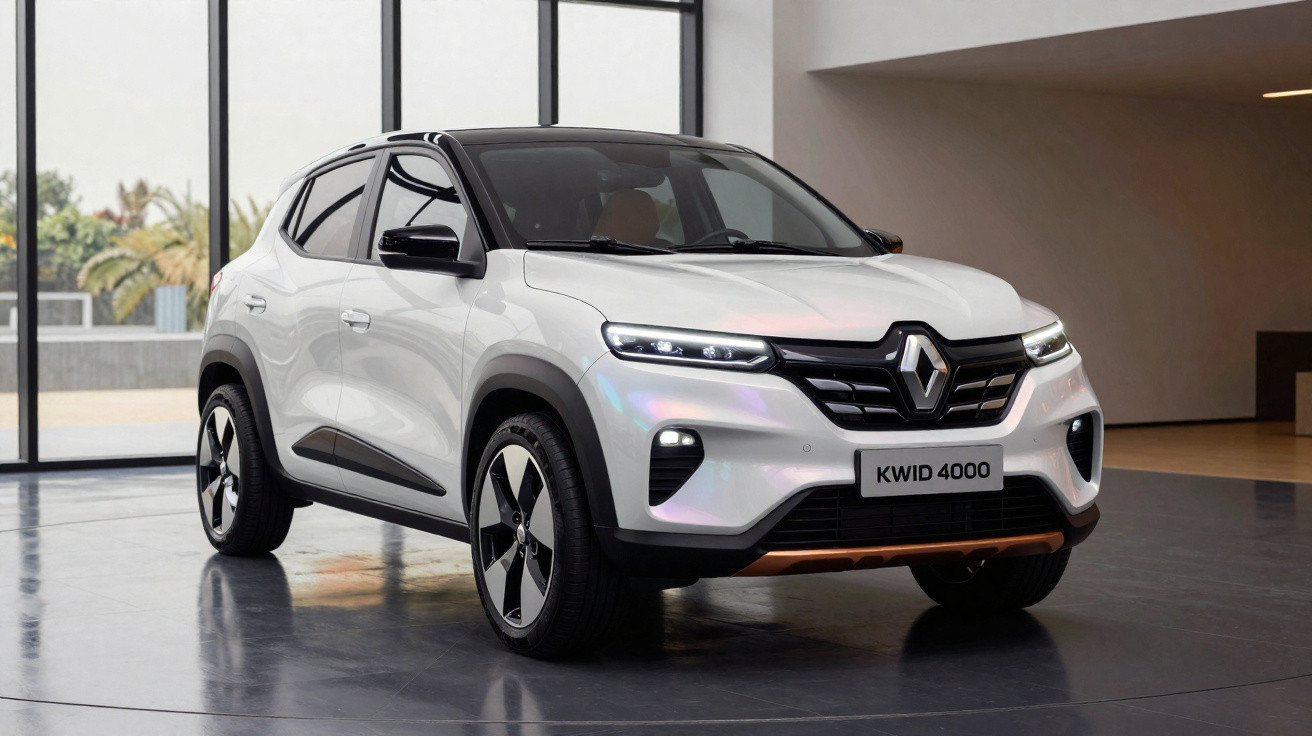
In India, there is a small car from the Dacia universe for around 4.000 Euro - with a petrol engine instead of electricity, while Europe misses out.
While European buyers have to pay a lot for the electric Dacia Spring, its combustion-engined sister model is built in India and other emerging markets for a fraction of the money. The gap is about far more than drivetrain choice: politics, charging infrastructure, local purchasing power and Renault/Dacia’s deliberate market strategy all play a part.
Budget Dacia for 4.000 Euro: what is this car really?
The model in question is called the Renault Kwid. Under the skin, it uses the same platform as the Dacia Spring - Renault Group’s low-cost electric city car. The key difference is that the Kwid is not an EV at all: it runs on petrol, and it is not officially offered to European customers.
Renault launched the Kwid in India in 2015. With close to 300.000 units sold, it became an important success for the brand there. Back then, the entry price worked out at roughly 2.900 Euro; today the basic version costs about 4.000 Euro - still well under a quarter of the starting price of a Dacia Spring in Western Europe.
"At its core, the Renault Kwid is a Dacia Spring for emerging markets - just with a small petrol engine instead of an electric drivetrain, and at a price European customers can only dream of."
Petrol instead of a battery: the technology behind the low-cost sister
The main separation is the drivetrain. Where the Dacia Spring is sold in Europe only as an electric car, the Kwid relies on a simple internal combustion set-up:
- Engine: 1.0-litre three-cylinder petrol
- Power: around 70 PS
- Top speed: about 150 km/h
- Gearbox: basic manual transmission or low-cost automatic options depending on the market
No large battery, no complex power electronics and no rapid charging - and that is precisely where the savings come from. In typical use cases across India, Brazil or South Africa, this kind of powertrain is entirely adequate: short journeys, urban driving and low average speeds.
Where the petrol “Spring” is on the road
The Kwid, and related versions of it, is now sold across multiple regions:
- India as the core market and the first production location
- Brazil and other Latin American markets such as Argentina and Colombia
- Parts of Africa, including South Africa
- Some Asian countries, such as Sri Lanka
Across all these markets, an ultra-low entry price matters far more than it does in Europe.
Why Europe gets the more expensive electric version
The fact that the Spring is electric in Europe has a straightforward explanation: EU policy applies heavy pressure towards e-mobility. Fleet targets, CO₂ limits and penalties push manufacturers to sell as many electric cars as possible in European markets.
At the same time, many countries support EV purchases with subsidies, which can dramatically reduce the headline cost. One comparison shows how large that effect can be:
| Model / market | Drivetrain | Base price approx. | With incentives |
|---|---|---|---|
| Renault Kwid (India) | Petrol | 4.000 € | no meaningful incentives |
| Dacia Spring (France) | Electric | 16.900 € | cheaper depending on bonuses |
| Dacia Spring (Italy, with support) | Electric | 16.900 € | down to approx. 4.900 € |
In Italy, generous incentives can temporarily bring the Spring to just under 5.000 Euro - almost level with the Kwid. In that scenario, the “affordable EV” calculation can actually work.
Why the numbers look different in Germany
In Germany and France, the picture has shifted. The Spring is imported from China, and because of a rule change it no longer qualifies for the eco-bonus in France. In Germany, state support for electric cars has been scrapped entirely. That removes the pricing advantage that made the small EV feel genuinely appealing to many buyers.
Even so, the group is sticking to the plan: Europe remains a clear target market for EV variants, while emerging markets keep combustion versions. In practice, that leaves no real route for a 4.000-Euro petrol car from the Dacia orbit to be sold here.
No budget petrol car for Europe: Renault holds the line
Many drivers in Germany would like a return to a simple, inexpensive petrol car. The Kwid can sound like exactly that: small, light, petrol-powered and under 5.000 Euro. But Renault is not playing along.
The company has repurposed models before. The Arkana SUV, for example, was originally intended for so-called emerging markets such as Russia, yet it ultimately made its way to Western Europe. With the Kwid, however, Renault is currently making it clear that an export to Europe is not planned.
"Anyone who wants to drive a new Dacia with a petrol engine for around 4.000 Euro has to travel to another country - and live there too, because the car is not designed for EU road use."
There are several reasons. EU requirements around safety, emissions rules, crash regulations and mandatory equipment are far stricter than in many emerging markets. A Kwid optimised for India would need such extensive re-engineering for Europe that most of its price advantage would largely disappear.
Why a bargain-basement car would struggle here
A look at typical EU expectations makes the issue clear:
- expanded airbag systems and stringent crash tests
- assistance systems such as autonomous emergency braking or lane-keeping
- tighter emissions limits and on-board diagnostics requirements
- noise and comfort standards buyers have come to expect
Each of these adds cost. The end result would no longer be a 4.000-Euro car, but a small car priced in the familiar range - and it would then compete directly with existing Dacia and Renault models.
What the pricing question reveals about the future of the cheap car
The Spring/Kwid story underlines how split the global car market has become. In India, the entry price is the dominant factor; in Europe, regulation and electrification shape the product. That produces very different cars, even when they start from the same platform.
For many customers in Germany, that is frustrating. They can see that, technically, a very cheap new car could be built - but that sort of car does not align with local political targets and safety expectations. As a result, the idea of a 4.000-Euro new car feels increasingly distant.
Anyone who simply wants basic transport is more likely to end up looking at used small cars. In that space, petrol vehicles still exist at prices of a few thousand euros. For new cars in Europe, reaching that level is likely to remain the exception for the foreseeable future.
Affordable electric cars: opportunity or dead end?
The Dacia Spring remains interesting because it demonstrates that a low-cost electric city car is, in principle, achievable. With substantial incentives the business case works; without state support, it becomes much harder. Manufacturers are now trying to get closer to lower price points again with minimalist, lightly equipped small EVs.
For buyers, that means: if you are willing to give up comfort, range and performance, you can reduce the price - but it is unlikely to ever be as radical as the Indian Kwid. Safety standards and European wage levels remain cost drivers that cannot simply be wished away.
Comments
No comments yet. Be the first to comment!
Leave a Comment